

Paper:
The use of the NeVa stent-retriever for bail-out mechanical thrombectomyAuthors:
Rory Fairhead, Marco Mancuso-Marcello, Rafee Ahmed, Keng Siang Lee, Christos Nikola, Katherine Parkin, Giovanna Klefti, Levansri Makalanda, Ken Wong, Joe Lansley, Michael Przyszlak, Oliver Spooner, Pervinder Bhogal
Journal:
Interventional Neuroradiology – SEPT 2025
Background:
Mechanical thrombectomy (MT) has become the gold-standard treatment for large vessel occlusion (LVO), however, in many cases, clots cannot be removed with the initial device. We assessed the safety and efficacy of the NeVa stent-retriever when used for bailout, in a real-world scenario where a range of initial devices have failed.Methods:
We reviewed our prospectively maintained database to identify all patients treated with the NeVa device after another device had failed to achieve satisfactory recanalization. We recorded the baseline demographics, NIHSS, pre- and post-MT imaging data including ASPECT score, eTICI scores, complications and 90-day Modified Rankin Score (mRS).
Results:
39 patients were included:
- Median age 70
- 67% male
- Median NIHSS at presentation: 17
- 11 (28%) received IV tPA prior to MT
Procedure prior to NeVa use:
- A single device was used prior to NeVa in 31 (74%) of cases
- 2 devices were used in the remaining 8 patients
- In total eTICI ≥ 2b recanalization was achieved in 4/39 patients (10%)
- 35 patients had insufficient recanalization (eTICI < 2b)
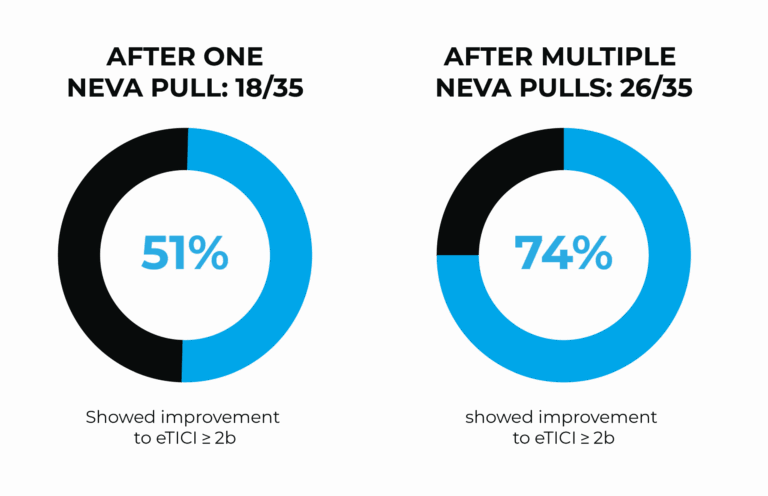
Recanalization improvement with NeVa:
- sICH: 2/39 (5.1%)
- SAH: 12/39 (31%)
- mRS ≤ 2 at 90 days: 8/35 (23%)
Conclusion:
The NeVa stent-retriever provides a useful adjunctive device in situations where other devices have failed to achieve recanalization. Early switching to NeVa rather than repeated pulls with an initial device may be beneficial for timely recanalization.
