




enVast
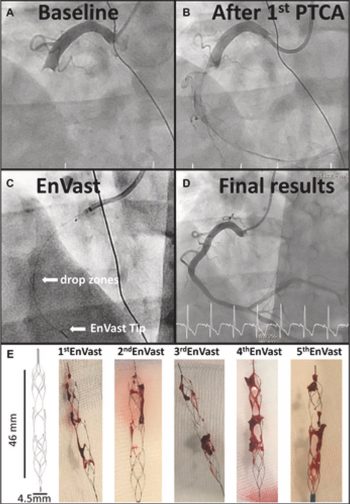
enVast™ 4.5 x 46 mm
Dario Bongiovanni, Francesco Loizzi, Antonio Landi, Léa Utsch, Marco Araco, Michael Joner, Marco Valgimigli
Cardiocentro Ticino Institute – Lugano, Switzerland
Humanitas Research Hospital – Milan, Italy
Technical University of Munich – Munich, Germany
enVast™ 4.5 x 37 mm
Dr Marco Valgimigli & Dr Antonio Landi,
Cardiocentro Ticino Institute – Lugano, Switzerland
Discover details on the case and procedural demonstration on PCR-online:
(Text translated into English from the original Spanish publication)
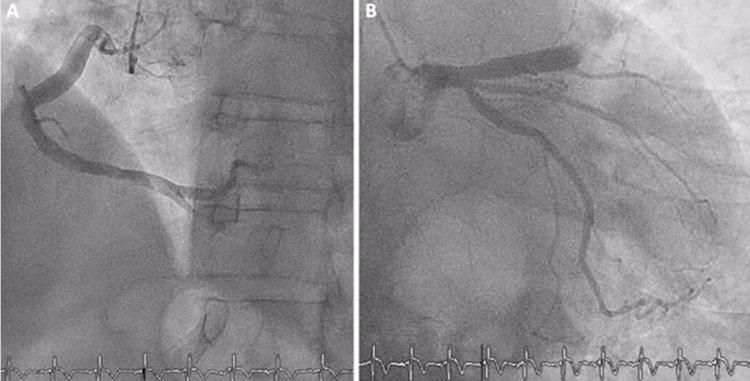
Thrombectomy in ST-segment elevation acute myocardial infarction (STEMI) is currently an infrequently used technique, as randomized studies have not demonstrated its efficacy and have been associated with a higher risk of stroke compared with balloon dilation. However, the treatment of STEMI with a large thrombotic burden remains a challenge. We describe here the first case in Spain involving a new thrombectomy system.
Dr Regina D. Costabile, Dr Salvatore Brugaletta
IDIBAPS, University of Barcelona, Spain
*NeVa (Vesalio, United States) was the designation used in the original publication; the product is currently referenced under the brand enVast
Dr Wijnard den Dekker,
Erasmus MC, Netherlands
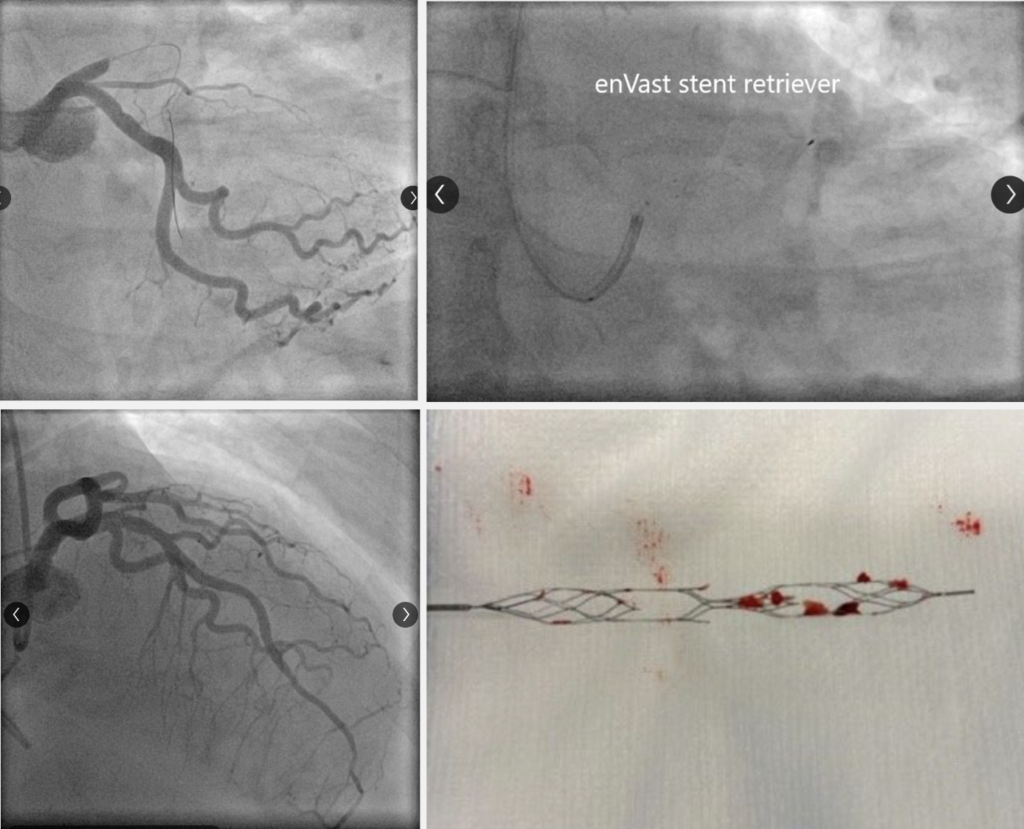
Thrombectomy in the context of ST-segment elevation acute myocardial infarction (STEMI) is infrequently employed, primarily due to a lack of conclusive evidence regarding its efficacy and concerns about an elevated risk of stroke compared to balloon dilation. Despite these reservations, managing STEMI cases with substantial thrombotic burden presents an ongoing challenge. This report details the inaugural implementation of a novel thrombectomy system in Spain.
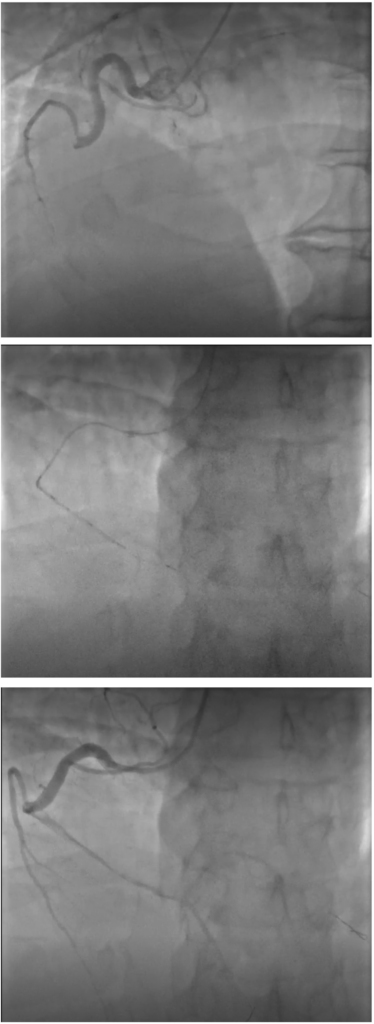
The subject is a 53-year-old male with a medical history encompassing type 2 diabetes mellitus, obesity, and a smoking habit. He was admitted to our hospital following an episode of lower STEMI. Coronary angiography revealed a thrombotic occlusion in the mid-segment of the right coronary artery, characterized by a notably high thrombotic load.
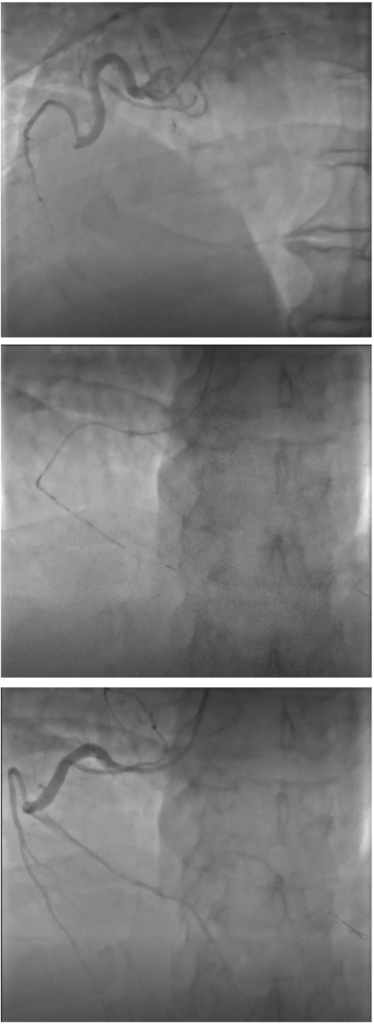
After failure of multiple attempts with balloon dilation and conventional thrombectomy techniques, the decision was made to employ the enVast system (NeVa, Vesalio, United States) as an alternative approach.
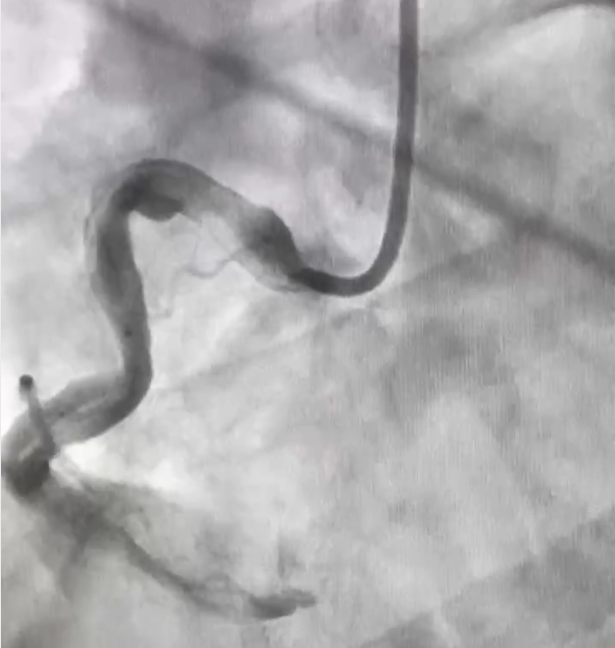
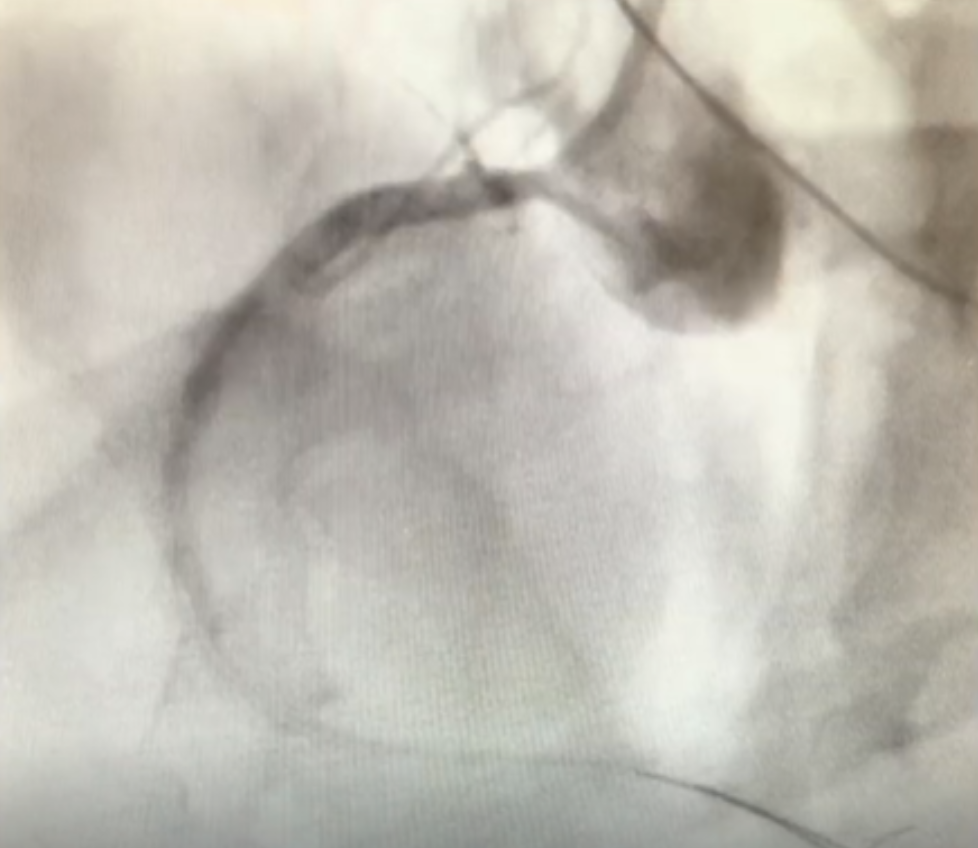
Two BMW guidewires were strategically placed at the posterior and posterolateral descending arteries. The posterior descending artery guidewire facilitated the insertion of a microcatheter up to the occlusion site. Subsequently, enVast was navigated through the microcatheter, which was then removed. To ensure continuous aspiration during retrieval, a guide catheter extension, equipped with three luerlock syringes, was utilized. This meticulous process with enVast effectively removed macroscopic thrombotic material and allowed for the visualization of the artery’s opening. The procedure was concluded with the implantation of two stents.
*enVast™
Dr Regina D. Costabile
Dr Salvatore Brugaletta
IDIBAPS, University of Barcelona, Spain
enVast™ 4.5 x 37 mm
Dr Katona Andras, Örebro University Hospital, Sweden
Dr Mohammad Alkhalil,
The Freeman Hospital, UK
| Cookie | Duration | Description |
|---|---|---|
| cookielawinfo-checkbox-analytics | 11 months | This cookie is set by GDPR Cookie Consent plugin. The cookie is used to store the user consent for the cookies in the category "Analytics". |
| cookielawinfo-checkbox-functional | 11 months | The cookie is set by GDPR cookie consent to record the user consent for the cookies in the category "Functional". |
| cookielawinfo-checkbox-necessary | 11 months | This cookie is set by GDPR Cookie Consent plugin. The cookies is used to store the user consent for the cookies in the category "Necessary". |
| cookielawinfo-checkbox-others | 11 months | This cookie is set by GDPR Cookie Consent plugin. The cookie is used to store the user consent for the cookies in the category "Other. |
| cookielawinfo-checkbox-performance | 11 months | This cookie is set by GDPR Cookie Consent plugin. The cookie is used to store the user consent for the cookies in the category "Performance". |
| viewed_cookie_policy | 11 months | The cookie is set by the GDPR Cookie Consent plugin and is used to store whether or not user has consented to the use of cookies. It does not store any personal data. |

by removing vascular occlusions and restoring blood flow
Please select your region to enter our world of innovation:
"*" indicates required fields